How to Build an Autonomous AI Sales Agent for Facebook Reels & Messenger
Discover how an automated n8n workflow powered by Google Gemini, Supabase pgvector, and Stripe turns viral Facebook Reels into frictionless, automated orders and real-time admin sync.
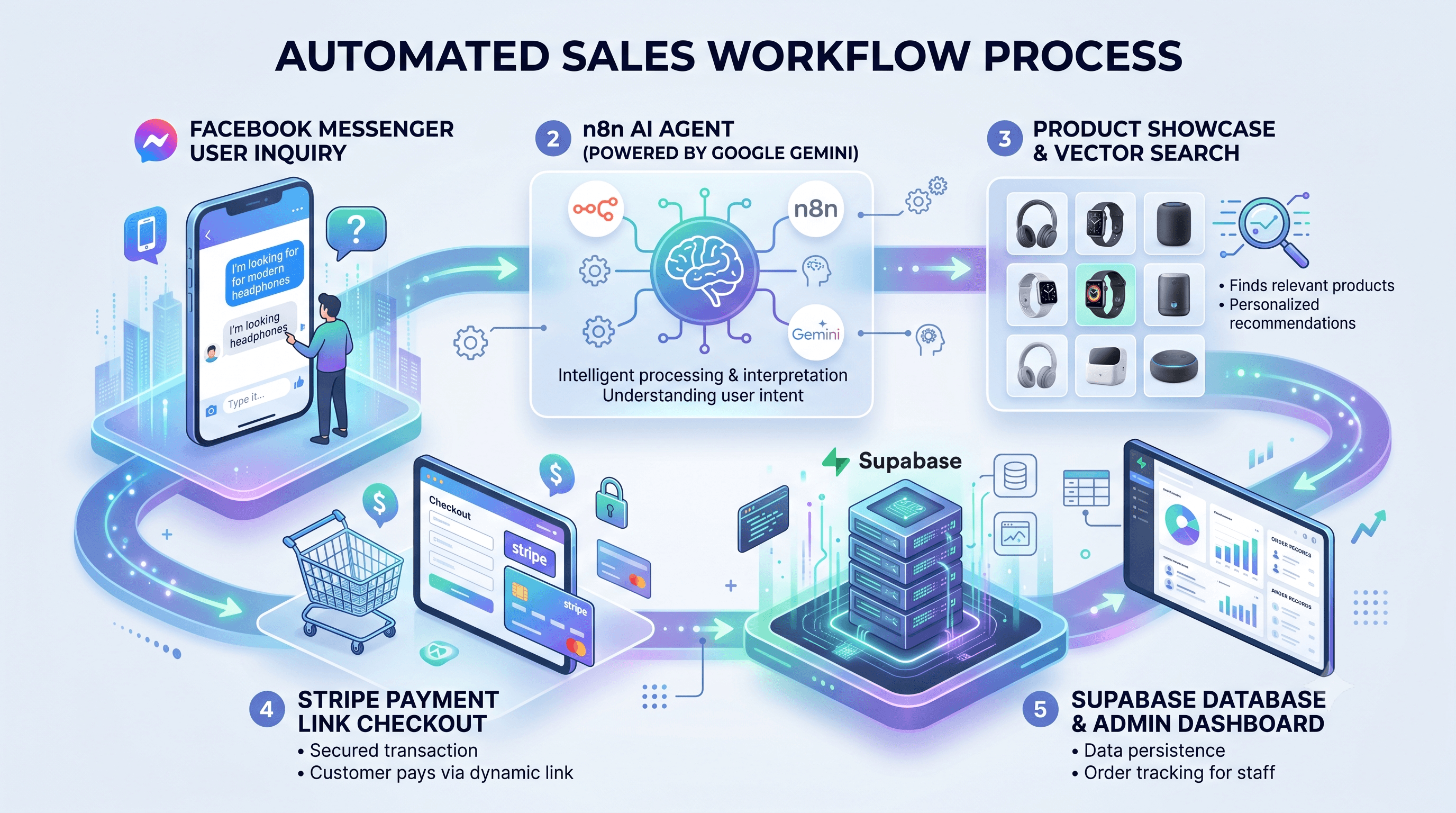
How to Build an Autonomous AI Sales Agent for Facebook Reels & Messenger — Legion Mind Architecture Dispatch
Key Architecture Takeaways
- Solves social commerce bottlenecks by responding to incoming Facebook Reels inquiries in under 2 seconds.
- Combines Google Gemini with Supabase pgvector semantic search to present accurate product recommendations in Messenger.
- Automates customer delivery intake and dispatches single-use Stripe payment links directly into the conversation.
- Persists all transactions and buyer records across a 14-table relational database managed via an intuitive admin portal.
Online businesses and retail brands promoting products through Facebook Reels and Instagram face a common revenue trap: converting sudden spikes in viral attention into verified customer orders without drowning in manual Messenger chats.
When a promotional Reel performs well, direct messages flood in at scale. Brand owners and small support teams are immediately overwhelmed answering repetitive pricing queries, confirming product variations, manually writing down shipping addresses on paper or spreadsheets, and checking bank balances for manual transfer receipts. In social commerce, every minute of response latency degrades buyer intent.
In this deep dive, we break down the architecture of a production-ready Autonomous AI Sales Agent orchestrated with n8n, Google Gemini, Supabase (pgvector), and Stripe. This system automates the buyer journey from the first Facebook message to payment settlement and fulfillment sync.
1. The Core Problem: The Social Selling Bottleneck
In conventional social commerce, the funnel breaks down during direct messaging:
Viral Reel ➔ Influx of DMs ➔ Hours of Delayed Replies ➔ Customer Leaves ➔ Abandoned Sale
- High Conversion Latency: Studies across social selling show that conversion probabilities plummet by over 80% if an initial product inquiry is not answered within 5 minutes.
- Scattered Fulfillment Records: Capturing customer addresses and phone numbers across chaotic Messenger threads leads to lost packages, incorrect variants, and fulfillment nightmares.
- High Payment Friction: Forcing shoppers to leave Messenger to find bank transfer details or fill out clunky multi-page checkout forms causes massive drop-off.
By replacing manual replies with an autonomous AI sales pipeline, brands achieve sub-2-second response times, automated product lookup, instant address collection, and 1-click checkout.
2. System Architecture & Information Flow
The pipeline connects Meta’s Graph API, intelligent LLM reasoning, semantic vector search, dynamic payment generation, and relational data persistence into a single reliable loop.

3. Step-by-Step Workflow Breakdown
Step 1: Meta Webhook Ingestion & Cryptographic Verification
When a customer sends a message on Facebook Messenger, Meta’s servers dispatch an HTTP POST webhook to your n8n endpoint.
To guarantee that incoming requests originate strictly from Meta and prevent replay or tampering attacks, the n8n flow passes the payload through a cryptographic verification node:
// n8n Verification Logic: Validate Meta HMAC-SHA256 signature
const crypto = require('crypto');
const signature = $headers['x-hub-signature-256'] || '';
const expectedSignature = 'sha256=' + crypto
  .createHmac('sha256', $env.META_APP_SECRET)
  .update($rawBody)
  .digest('hex');

return {
  json: {
    valid: crypto.timingSafeEqual(Buffer.from(signature), Buffer.from(expectedSignature)),
    senderId: $json.entry[0].messaging[0].sender.id,
    messageText: $json.entry[0].messaging[0].message.text,
  }
};
If the signature matches, execution continues; spoofed or unauthorized requests are rejected immediately.
Step 2: Contextual Intelligence with Google Gemini
Traditional rule-based chatbots break when users make typos, use slang, or ask complex questions. This system leverages Google Gemini as the conversational reasoning engine:
- Intent Recognition: Identifies whether the shopper is asking about pricing, browsing categories, inquiring about shipping policies, or ready to place an order.
- Entity Extraction: Dynamically extracts specific attributes such as product size (
Large), color (Matte Black), quantity, and delivery preferences. - Natural Persona: Maintains a helpful, professional brand voice that guides the shopper toward checkout without feeling robotic.
Step 3: Semantic Product Matching with Supabase pgvector
Instead of relying on rigid keyword search, the AI agent performs semantic retrieval against a vector database.
- Product titles, descriptions, and variant attributes are converted into high-dimensional vector embeddings using Google's text-embedding models.
- When a shopper asks "Do you have any lightweight running gear in dark colors?", the customer's query is converted to an embedding.
- Supabase evaluates cosine distance via the
pgvectorextension to return the most relevant catalog items:
-- Stored procedure in Supabase for sub-second semantic catalog lookup
CREATE OR REPLACE FUNCTION match_products (
  query_embedding vector(768),
  match_threshold float,
  match_count int
)
RETURNS TABLE (
  id uuid,
  name text,
  description text,
  price numeric,
  stock_quantity int,
  image_url text,
  similarity float
)
LANGUAGE plpgsql
AS $$
BEGIN
  RETURN QUERY
  SELECT
    p.id,
    p.name,
    p.description,
    p.price,
    p.stock_quantity,
    p.image_url,
    1 - (p.embedding <=> query_embedding) AS similarity
  FROM products p
  WHERE p.stock_quantity > 0
    AND 1 - (p.embedding <=> query_embedding) > match_threshold
  ORDER BY similarity DESC
  LIMIT match_count;
END;
$$;
The AI formats the query results and sends them directly into Messenger with high-resolution product images, pricing, and variant options.
Step 4: Automated Order & Delivery Details Intake
Once the customer confirms the item they want to purchase:
- The AI agent asks for the customer's Full Name, Shipping Address, Postal Code, and Mobile Phone Number.
- It validates the shipping data for completeness (ensuring the zip code and phone format are valid).
- The conversation state is stored in Postgres so that if the customer pauses and returns 20 minutes later, the context is preserved.
Step 5: Dynamic 1-Click Stripe Checkout Generation
Rather than redirecting the shopper to an external storefront where they have to search for the item again:
- n8n calls the Stripe API to create a dynamic single-use Stripe Checkout Session.
- The session payload includes the specific product SKU, quantity, customer email, and shipping metadata.
- The agent sends the link directly into the Messenger thread:
"Here is your secure checkout link to confirm your order: https://checkout.stripe.com/c/pay/cs_live_... Your items will be reserved for 30 minutes."
The shopper taps the link, completes payment in seconds using Apple Pay, Google Pay, or Credit Card, and is redirected back with an immediate confirmation.
Step 6: 14-Table Relational Persistence & Webhook Signature Check
Upon successful payment, Stripe dispatches a checkout.session.completed event to an n8n webhook node.
The workflow cryptographically verifies the Stripe webhook signature (Stripe-Signature) to guarantee legitimacy, and then executes transactional writes across 14 relational tables:
├── 1. customers          (Identity, contact, total lifetime value)
├── 2. conversations      (Session metadata, channel origin)
├── 3. messages           (Complete audit trail of user & AI dialog)
├── 4. orders             (Order ID, total amount, currency, status: Paid)
├── 5. order_items        (SKU references, unit prices, quantities)
├── 6. payments           (Stripe transaction ID, fee breakdown, receipts)
├── 7. shipping_addresses (Standardized recipient delivery coordinates)
├── 8. inventory_logs     (Automated stock decrement & reserve holds)
├── 9. fulfillment        (Tracking numbers, carrier assignments, labels)
├── 10. audit_logs        (Security events, state transitions)
├── 11. product_variants  (Color, size, dimensional specs)
├── 12. discount_codes    (Applied promotions, referral tracking)
├── 13. business_settings (API keys, operational hours, currencies)
└── 14. admin_users       (Role-based access credentials for dashboard)
4. The Business Owner Admin Portal
A critical aspect of this architecture is that business owners and warehouse staff never have to touch n8n or edit code to manage orders.
The system connects to an intuitive Admin Web Application:
- One-Click Facebook & Stripe Connect: Store owners connect their Facebook Page and Stripe account directly through a clean Settings page in the admin portal—no complex credential setup in n8n is required.
- Live Fulfillment Board: New orders appear in real-time with shipping labels ready to print.
- Customer Audit Trail: Support managers can view the full transcript of what the AI discussed with any customer alongside their verified transaction record.
- Inventory Controls: Updating stock or adding a new product automatically updates the
pgvectorembeddings in the background.
5. Live Demonstration & Video Walkthrough
To see this automated pipeline operating in real-time—from an initial customer DM on Facebook to Stripe checkout link generation and admin portal order tracking—watch our full video demonstration:
[!TIP] Video Walkthrough Available: Watch the step-by-step workflow in action: 🎬 Watch the Autonomous Facebook AI Sales Workflow Demo The walkthrough demonstrates the live Messenger exchange, real-time product recommendations, Stripe checkout generation, and the admin dashboard order sync.
6. Performance Benchmarks: Manual vs Autonomous
| Operational Metric | Manual Staff Handling | Autonomous AI Pipeline |
|---|---|---|
| First Response Latency | 15 mins to 8 hours | < 2.0 seconds |
| Availability | Working hours only | 24/7/365 uninterrupted |
| Simultaneous Concurrency | 2–4 chats per agent | 1,000+ parallel chats |
| Checkout Flow | Manual bank transfer / invoicing | 1-Click Stripe payment link |
| Order Logging Accuracy | Frequent manual entry errors | 100% automated database sync |
| Cart Recovery | Rarely followed up | Automated reminder after 15m |
7. Production Implementation Checklist
For engineering teams and agencies planning to roll out this architecture for retail clients:
- n8n Orchestration Environment: Self-hosted on a secure VPS or n8n Cloud instance with webhook endpoints enabled.
- Meta Developer App: Create a Facebook Developer App, subscribe to the
messagesandmessaging_postbackswebhooks, and obtain a Page Access Token. - AI Model API Keys: Google Gemini API credentials configured with adequate rate limits for peak viral traffic.
- Supabase Setup: Deploy a PostgreSQL instance with the
vectorextension enabled (CREATE EXTENSION IF NOT EXISTS vector;). - Execute Initial Setup Node: Run the "Run once: create tables and first login" automation node to scaffold all 14 data tables and initialize the admin portal.
- Stripe Webhook Signing Secret: Configure Stripe endpoints to forward
checkout.session.completedevents with signature verification.
Conclusion
Converting social media traffic into revenue requires minimizing friction at the exact moment customer intent is highest. By pairing Google Gemini for natural conversational handling with Supabase pgvector for catalog discovery, Stripe for frictionless checkout, and n8n for seamless integration, retail brands can turn viral Facebook Reels into an automated, 24/7 revenue engine.
Related Technical Dispatches


Production Runbooks & Architecture Notes
Monthly technical dispatches covering Linux VPS hardening, strict DMARC deliverability, Next.js optimization, and cloud operations. Zero sales fluff.